- About Us
- Membership
- Practice
- Education
- Research
- Meetings
- Journal
- Newsletter
- Donate
|
HISTORY OF THE ARS
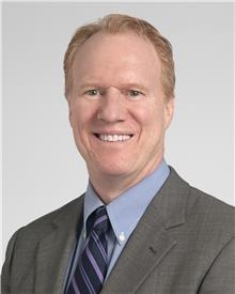
Michael Benninger, MD
Historian
During a course in Rhinologic Medicine presented by Dr. Maurice H. Cottle at Johns Hopkins Hospital in 1954, it was decided that the then-fledgling interest in Rhinology should be encouraged and continued within the framework of an organized professional society. It was in this milieu that the American Rhinologic Society was formed. Initially, the Society focused upon the evaluation and treatment of problems related to the nasal septum and external bony pyramid. Both functional and cosmetic factors were emphasized. The group soon evolved to include the evaluation and management of diseases of the paranasal sinuses. More recently, Society members have emphasized endoscopic sinus surgery, technical advances, new applications, and the expanding role of rhinology in skull base surgery and patient care. A Legacy of Innovation
1944 Cottle begins lectures, surgical demonstrations, and anatomical teaching for Chicago-area otolaryngologists. 1949 Formal courses address the anatomy, physiology, and aesthetic aspects of the nose. 1954 A seven-day course at Johns Hopkins becomes the setting for the preliminary organization of the Society. 1957 The first ARS course at Yale follows the 6th International Congress in Otorhinolaryngology. 1970s Cottle continues teaching at ARS meetings and postgraduate courses until his death in 1981. 1980s Rigid nasal endoscopy transforms the diagnosis and treatment of sinonasal disease. 2004 The ARS celebrates its 50th Anniversary in New York and establishes the Annual David W. Kennedy Lectureship. MAURICE H. COTTLE, M.D.
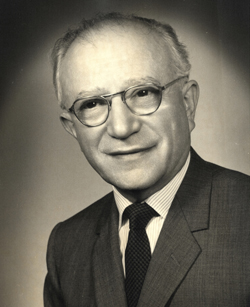 Maurice H. Cottle, M.D. (1898–1981) founded the American Rhinologic Society in 1954. His influence on rhinology extended well beyond the organization itself, through his teaching, surgical innovations, and emphasis on understanding the anatomy and physiology of the nose. In the fall of 1944, with the cooperation of the Illinois Masonic Hospital, the Cook County Graduate School of Medicine, and the Institute of Medicine of Chicago, Cottle presented a series of lectures as well as surgical and anatomical demonstrations to otolaryngologists in the Chicago area. Shortly thereafter, Dr. Cottle developed a more formal course that attracted specialists from many parts of the United States. Dr. Samuel Foman led this early effort, which continued a pioneering teaching program begun in Boston and New York. THE COTTLE COURSES
By 1949, interest had developed sufficiently to support a course dedicated to the anatomic and physiological aspects of the nose as well as its aesthetic aspects. Cottle presented the course at Illinois Masonic Hospital with the cooperation of Dr. Ralph H. Riggs, Dr. Roland M. Loring, Dr. James Chessen, and Dr. George G. Fischer. Similar courses, conferences, lectures, and seminars were subsequently given throughout the United States. These presentations became known as the "Cottle Seminar" or "Cottle Courses." 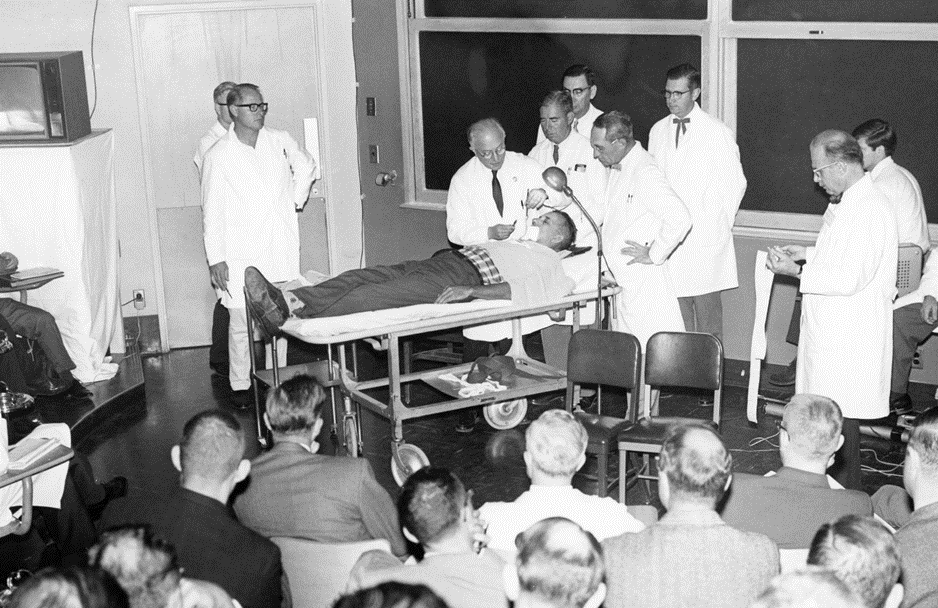 Historical Cottle teaching course
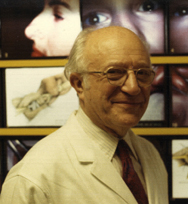 Maurice Cottle teaching rhinologic surgery
PRESERVING THE NASAL FRAMEWORK
In the 1940s, otolaryngologists were primarily trained in the classic "submucous resection" of nasal septal cartilage. Cottle and his colleagues developed and taught a different approach, emphasizing preservation of the cartilaginous septum and an intranasal maxilla–premaxilla approach to septal surgery. Around 1950, Cottle, Loring, and Fischer formally presented this approach. The technique became an important component of the teaching that brought groups of otolaryngologists together to refine and disseminate new approaches to nasal surgery. 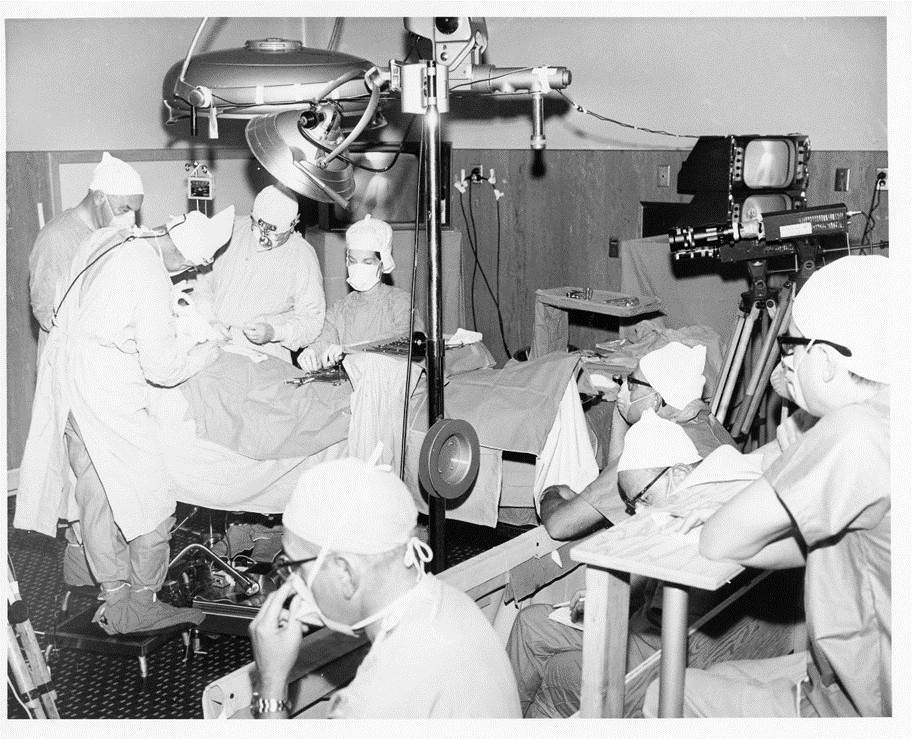 Historical rhinologic operating room
THE FORMATION OF THE ARS
 The early organization was initially referred to as "The Cottle Society." In October 1954, a seven-day course was held at Johns Hopkins Hospital. During that meeting, Dr. Ralph Riggs of Shreveport, Louisiana, announced that preliminary legal steps had been taken to form a society devoted to the investigation, study, and teaching of all medical and surgical phases of rhinology and its associated sciences. The first officers were elected at this meeting: Maurice H. Cottle, MD — President Ralph Riggs, MD — Vice President Roland Loring, MD — Secretary George Fisher, MD — Treasurer Kenneth H. Hinderer, MD — Chairman, By-laws and Organization Of the 39 charter members, 18 eventually served as presidents of the ARS. Thirty-eight of the 39 would ultimately be awarded the Golden Head Mirror, the Society's highest honor, recognizing meritorious service to rhinology. The first 30 years of the Society were led by many of these founding members, and many subsequent leaders were mentored by them. Dr. Ralph Riggs, from Shreveport, Louisiana, served as president in 1955. Dr. Fred Stucker, also from Shreveport, served as president in 1992 and subsequently as secretary. THE EARLY ARS COURSES
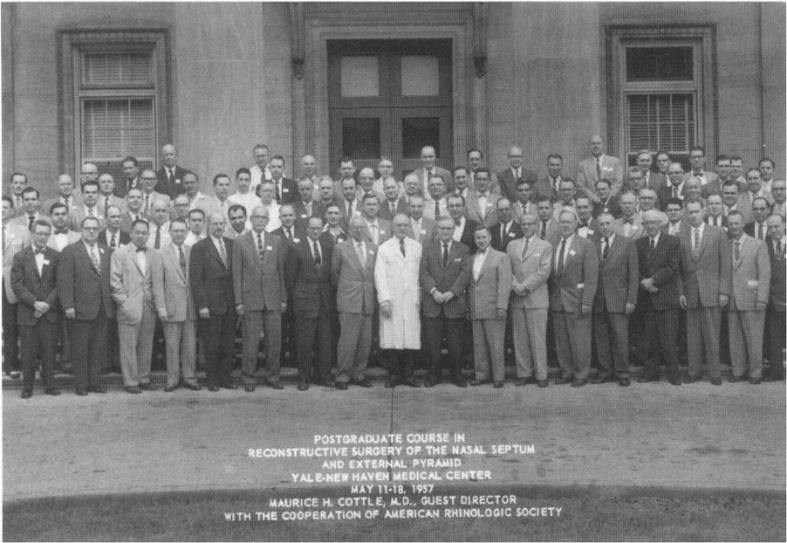 Participants in an early American Rhinologic Society course at Yale in 1957, following the 6th International Congress in Otorhinolaryngology in Washington, DC.
From the Society's inception, Dr. Cottle continued to teach at many ARS meetings and ARS-sponsored postgraduate courses through the 1970s, continuing until his death in 1981. The Society's educational mission also developed an international dimension. Courses expanded to locations including Holland, Denmark, and Mexico, with joint meetings bringing American and European rhinologists together. Cottle was instrumental in the founding of both the European Rhinologic Society and the International Rhinologic Society, including the International Rhinologic Society meeting in Kyoto, Japan, in 1961. UNDERSTANDING NASAL PHYSIOLOGY
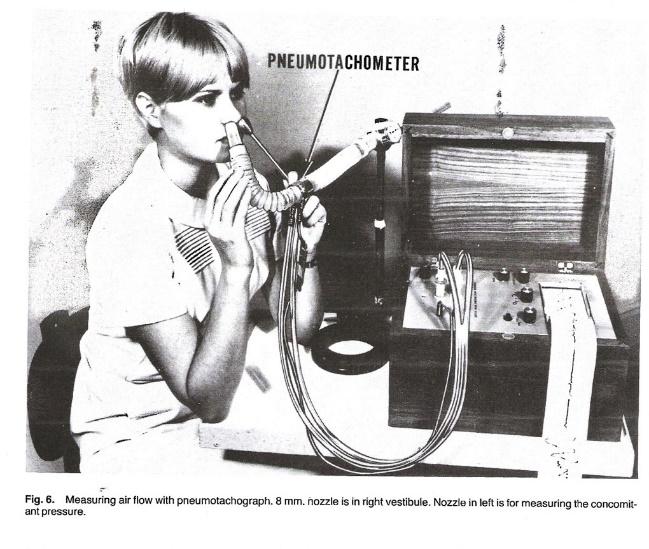 Historical nasal airflow measurement
Early nasal reconstructive techniques were increasingly informed by investigations into the physiology of the nasal airway. Historical work included attempts to measure airflow dynamics within the nasal cavity in response to anatomic deviations and disease. Early devices and techniques were used to establish respiratory parameters and to follow outcomes after medical and surgical treatment. This growing attention to objective assessment reflected the Society's broader interest in understanding not only the appearance of the nose, but also its structure and function. THE EVOLUTION OF SINUS SURGERY
The Caldwell-Luc procedure had been described in the late nineteenth century by George Caldwell in 1893 and Henry Luc in 1897. For many years, relatively few advances changed the surgical management of chronic sinus disease. Sinus surgery was generally performed through the anterior nares using a headlight or microscope to open the sinuses and remove diseased tissue. By the late 1960s, partly through the work and influence of ARS members, there was growing interest in reestablishing the functional sinus ostium and relieving symptoms by addressing the anatomy and physiology of sinus drainage. The term "MORI"—Maxillary Ostial Region Inadequacies—was used in this context and prompted clinical investigation that contributed to the physiologic principles underlying modern sinonasal management. THE ENDOSCOPIC REVOLUTION
In the 1980s, rhinology experienced a dramatic rebirth in the United States and abroad through the use of the rigid nasal telescope. Although Hirshman had performed an endoscopic sinonasal examination with a modified cystoscope in 1901, it was not until 1978 that Professor Walter Messerklinger of Graz, Austria, advocated the use of the rigid telescope for sinonasal diagnosis and limited surgery in the treatment of rhinosinusitis. 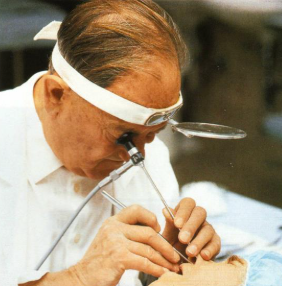 Walter Messerklinger operating
Dr. David W. Kennedy recognized the key role the telescope would play in the diagnosis and treatment of sinonasal disease and brought this technique to the United States after attending a presentation by Professor Messerklinger in the former Yugoslavia. Dr. Kennedy played a key role in developing and disseminating the technique through teaching and clinical innovation. His tireless teaching and devotion to rhinology and the ARS were honored at the Society's 50th Anniversary Meeting in September 2004 in New York, where he delivered the first Annual David W. Kennedy Lectureship established in his honor. FIFTY YEARS OF RHINOLOGY
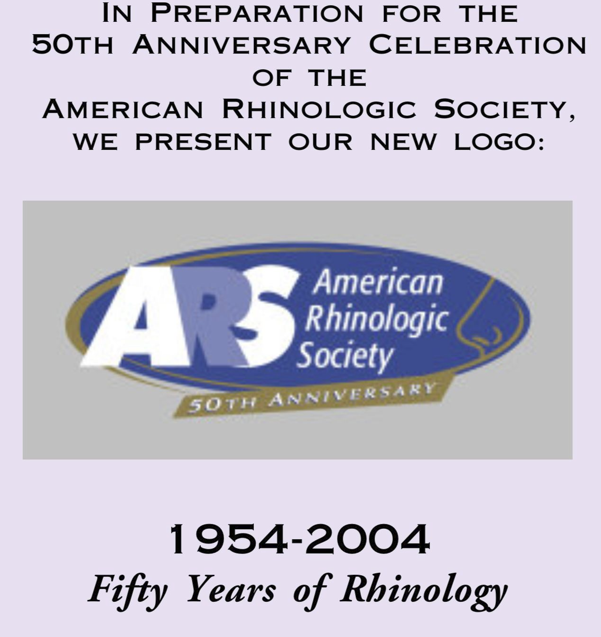 The 50th Anniversary Meeting in New York marked an important milestone for the Society and celebrated the individuals whose teaching, research, and service helped establish rhinology as a distinct and continually evolving field. GROWTH OF THE SOCIETY
Following the introduction and dissemination of endoscopic sinus surgery in the 1980s, the ARS experienced rapid growth, accompanied by an expansion of formal meetings and educational activities. For many years, Society administration was largely handled through the office of the Secretary, initially based in Chicago. During George Facer's tenure as Secretary, the Society's offices moved to Rochester, Minnesota. In 2000, Marvin Fried served as Secretary and hired Wendi Perez as Administrative Assistant. The Society subsequently became increasingly supported through that administrative office, providing continuity as the organization expanded.  Historical American Rhinologic Society wordmark
PROFESSIONALIZING THE ORGANIZATION
As the ARS matured, its growing activities eventually required an organizational structure capable of supporting an increasingly complex national society. In 2014, the Society created the position of Executive Vice President. Under President Tim Smith, the leadership recognized that the ARS had outgrown a model in which virtually all organizational decisions were managed solely by elected physician volunteers. Stable physician executive leadership was established alongside the administrative team. Joseph Jacobs brought extensive prior service to the role, having served on the Board, as President, as Treasurer beginning in 2008, and as Chair of the Development Committee beginning in 2010. He became the Society's first Executive Vice President in 2014. THE ARS AND THE SCIENTIFIC LITERATURE
The Society's commitment to education and scientific communication also developed through its relationship with the rhinologic literature. In 1987, under Guy Settipane, Oceanside Publications first published the American Journal of Rhinology. Joel Bernstein became the first otolaryngologist to serve as section editor for abstracts. In 1989, David Kennedy was invited to become Co-Editor in Chief, and the journal increasingly focused on rhinology and otolaryngology rhinology. 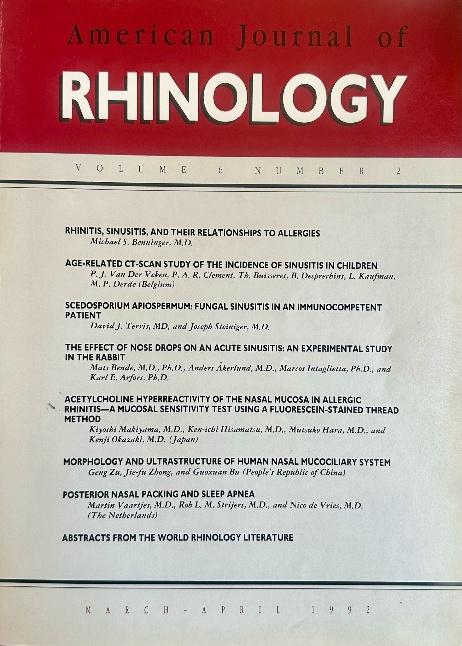 American Journal of Rhinology
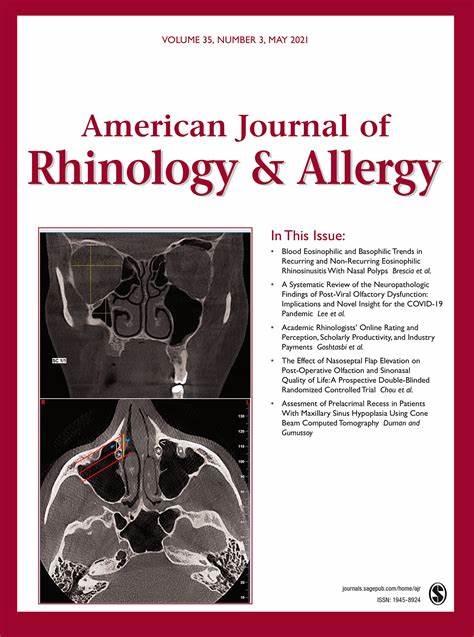 American Journal of Rhinology and Allergy
Mandatory submissions began in the late 1990s. The journal subsequently changed its name to the American Journal of Rhinology and Allergy, while ARS members continued to contribute extensively to the publication. In 2010, a joint relationship with the American Academy of Otolaryngic Allergy led to the establishment of the International Forum of Allergy & Rhinology.  International Forum of Allergy and Rhinology and ICAR
SELECTIVE MILESTONES
1978 First ARS newsletter; publication was intermittent until the 1990s. 1998 Corporate Affiliates Program established under Paul Toffel, later transitioning into the Development Committee and ultimately the Vice Presidencies of Development and Strategic Initiatives. 1998 First Strategic Planning Retreat held in Dallas. 1998–2011 Sinus and Allergy Health Partnership involving the AAO-HNS and AAOA. 2012 Summer Sinus Symposium established. 2014 Executive Vice President position created. 2018 Women in Rhinology becomes a formal ARS Section. THE MODERN ARS
The membership of the ARS has grown rapidly during its more than seven decades of existence. Although the Society continues to study nasal structure and function, much of its present focus is on the diagnosis and treatment of rhinosinusitis and other sinonasal disorders. The specialty has expanded into endoscopic resection of skull base and intracranial lesions. At the same time, the Society has become a leader in advocating for patients and for the care provided by their physicians in an ever-changing health care environment in the United States. Throughout its history, the Society has remained an organization driven by dedicated physician-scientists who volunteer their time and resources to advance education, research, patient care, and the dissemination of knowledge in rhinology. 
"The future belongs to those who believe in the beauty of their dreams."
— Eleanor Roosevelt
A Continuing Legacy
From the early Cottle courses to today's multidisciplinary rhinology, skull base surgery, research, advocacy, and education, the American Rhinologic Society continues to build upon a tradition of innovation, teaching, scientific inquiry, and service. |