- About Us
- Membership
- Practice
- Education
- Research
- Meetings
- Journal
- Newsletter
- Donate
|
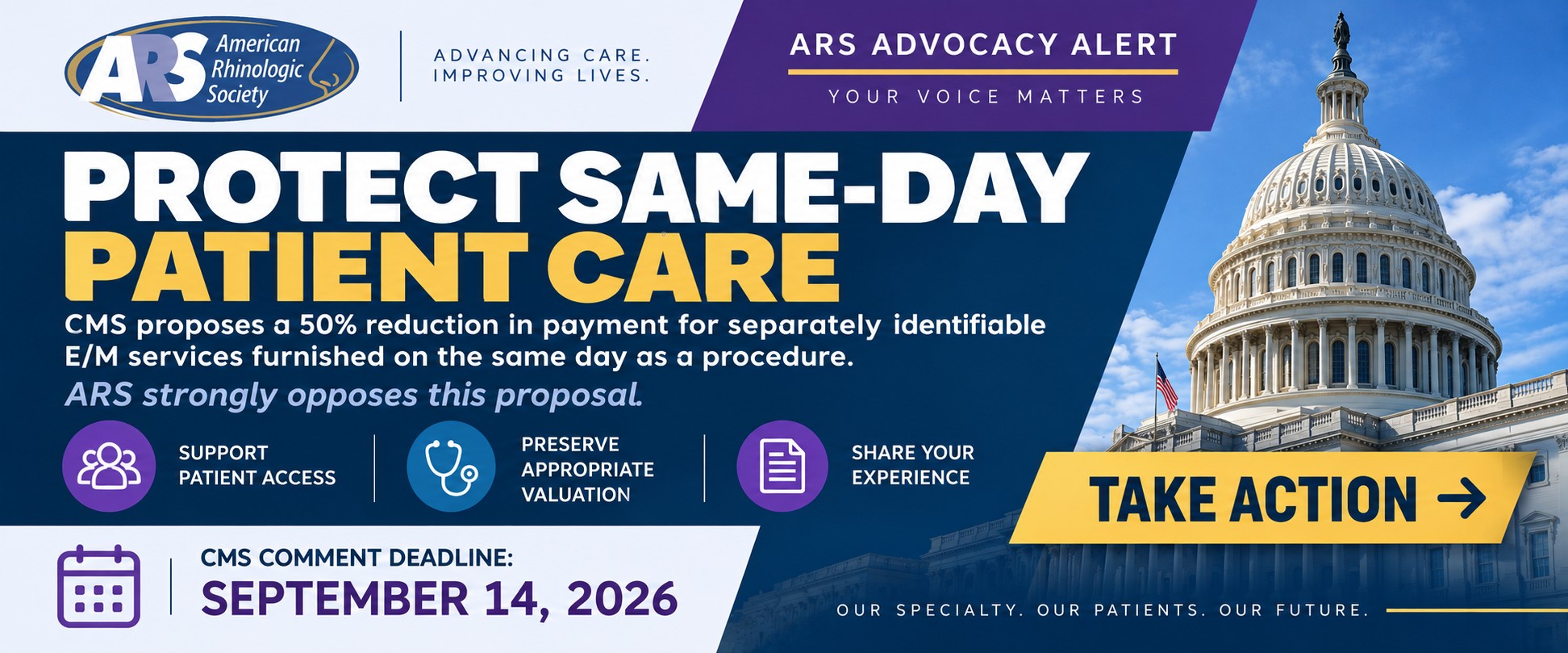
ARS strongly opposes the proposed 50% reduction.
The proposal would reduce payment for a service that, under CMS's existing billing requirements, must represent work beyond the usual work associated with the procedure. ARS urges CMS not to finalize the proposed reduction and to ensure that any payment changes are supported by evidence regarding the resources required to furnish the affected services.
Why ARS Is ConcernedThe Calendar Year 2027 Medicare Physician Fee Schedule proposed rule would have a substantial negative directional impact on otolaryngology. ARS is particularly concerned about the cumulative effect of multiple payment policies on rhinology practices, including independent and office-based practices. A stable and predictable Medicare payment system is necessary to sustain access to specialized rhinologic care. Within this broader context, ARS strongly opposes CMS's proposal to reduce payment by 50 percent when a separately identifiable office/outpatient E/M service is furnished on the same day as a procedure with a 0-, 10-, or 90-day global period. Take Action Before September 14ARS is asking every member to participate in the public comment process and help demonstrate why this proposal should not be finalized.
Understanding the Modifier 25 ProposalModifier 25 identifies a significant, separately identifiable E/M service above and beyond the usual preoperative and postoperative care associated with a procedure. CMS's proposal would nevertheless reduce payment by 50 percent for these services when they are furnished on the same day as a procedure with a 0-, 10-, or 90-day global period. ARS's concern is straightforward: if an E/M service must already meet CMS's requirements for separate reporting under Modifier 25, CMS should identify and quantify what additional duplicative work or practice expense remains—and demonstrate why any remaining overlap would uniformly justify a 50 percent reduction. The Case Against the Proposed ReductionArgument 01
CMS Has Not Demonstrated What Additional Overlap RemainsCMS has not demonstrated residual duplicative physician work or practice expense after existing valuation adjustments. The frequency with which an E/M service and procedure are reported together does not, by itself, establish the magnitude of resource overlap. Nor has CMS explained why any remaining overlap would uniformly equal 50 percent. ARS urges CMS not to finalize the proposed reduction. Argument 02
CMS Has Already Accounted for Same-Day E/M Overlap in Certain ValuationsCPT code 31231, diagnostic nasal endoscopy, provides a particularly clear example. During valuation, same-day E/M overlap was expressly recognized, and 12 minutes were removed from the standard pre-service time package. CMS subsequently conducted its own review and reduced post-service time from five minutes to three minutes. The current valuation therefore reflects multiple explicit adjustments for same-day E/M overlap, including an adjustment independently imposed by CMS. The proposed 50 percent reduction would impose another adjustment without demonstrating what additional overlap remains. Argument 03
Payment Changes Should Be Based on Evidence of the Resources Required to Furnish CareARS supports accurate physician payment and recognizes the importance of identifying and addressing true resource overlap. However, broad reductions should not substitute for an analysis of the specific physician work and practice expense associated with individual services. If CMS believes duplicative payment exists, it should identify and quantify the specific duplicated resources. Argument 04
The Impact on Patient Access Must Be ConsideredThe proposed reduction should be considered within the broader context of the cumulative payment changes affecting otolaryngology and rhinology practices. A stable and predictable Medicare payment system is necessary to sustain access to specialized rhinologic care, particularly in independent and office-based practices. ARS urges CMS to evaluate payment policies collectively and to consider their effects on the sustainability of practices and beneficiary access to specialized care. Tell CMS What This Means in Your PracticeYour individual clinical experience can help demonstrate how same-day E/M services and procedures are furnished in real-world practice. Consider describing specific situations in which a patient requires both a separately identifiable E/M service and a procedure during the same encounter. Examples you might include:
Our Message to CMSIf CMS believes duplicative payment exists, it should identify and quantify the specific duplicated resources. Payment changes should be supported by evidence regarding the resources required to furnish the affected services and should preserve access to specialized care. Use the ARS Comment Letter TemplateARS has prepared a comment letter template incorporating the Society's concerns with the proposed 50 percent reduction. Personalize the template with your own clinical experience and practice-specific information before submitting your comment. Individualized comments are encouraged. Your firsthand experience can help CMS understand the clinical and operational implications of the proposed policy. DOWNLOAD THE ARS COMMENT LETTER →Ask Congress to Support OversightIn addition to submitting comments to CMS, ARS encourages members to contact their U.S. Senators and Representative. Suggested Message
Ask CMS to provide the evidence supporting the proposed 50 percent reduction and to carefully evaluate the impact of the policy on physician practices, patients, and access to specialized care. CMS Public Comment Deadline
September 14, 2026Submit your comment to CMS by 5:00 PM ET on September 14. SUBMIT YOUR COMMENT NOW →Protecting access to specialized rhinologic care requires a stable and predictable Medicare payment system. The American Rhinologic Society appreciates the engagement of its members in this important advocacy effort. |